
Why Hing? The “Ghis-Pita” Ingredient Our Nanis Relied On -And What Modern Research Says

Let’s be honest. When you hear the word Hing (Asafoetida), you probably think of that unmistakable aroma floating out of the kitchen during a tadka — or your grandmother insisting that a little hing was the answer whenever someone complained about an upset tummy.

For generations, Indian families have relied on simple kitchen ingredients and traditional Nani Maa nuskhas as part of everyday care.
Today, we live in a world of modern research, carefully formulated products and increasingly conscious parents.
So, what happens when generational wisdom meets modern product development?
That is the story behind the herbs used in traditional tummy-care practices — and the inspiration behind the ADNA Naturals Tummy Roll-On.
The Generational Legacy: What Did Our Ancestors Know?
Long before these ingredients appeared on a modern product label, Hing, Sowa, Saunf, Adrak, Pudina and Ajwain were familiar ingredients in Indian kitchens and traditional wellness practices.
They weren't simply flavoring agents. Many of these herbs have a long history of traditional use for digestive comfort.
Hing (Asafoetida)
Hing is a pungent botanical resin that has been used traditionally in Indian cooking and wellness practices. Its strong aroma and traditional association with digestive comfort are probably why it became such a familiar part of many household remedies.
Adrak (Ginger)
Ginger has a long history of traditional use for digestive comfort and nausea. Its naturally occurring compounds, including gingerols, have also been studied extensively for their biological activity.
Ajwain & Saunf
Ajwain and fennel are familiar post-meal ingredients in many Indian households.
Fennel, in particular, has been studied in relation to infantile colic. One randomized, placebo-controlled study involving infants with colic found that a specific fennel-seed-oil emulsion reduced colic symptoms compared with placebo.
However, this should not be interpreted as evidence that every fennel-containing product - or every topical preparation, has the same effect.
Sowa (Dill) & Pudina (Mint)
Dill and mint have also been traditionally associated with digestive comfort. Some herbal preparations containing these types of ingredients have been studied, although evidence in infants remains limited and varies considerably between preparations.
A Quick Question for You
Think back to your own childhood or family stories.
Did your mother or grandmother ever reach for hing, ajwain, saunf or another kitchen ingredient when someone had an uncomfortable tummy?
For many Indian families, these small traditions became part of everyday childhood memories.
And that is how Nani Maa nuskhas travelled from one generation to the next.

From Grandmother to Mother: How Traditional Wisdom Evolved
Traditional practices survived because families continued to use, adapt and pass them on.
A grandmother might have relied on a simple household preparation.
The next generation became more conscious of ingredients, quantities and hygiene.
Today's parent wants something different again:
Convenience. Consistency. Quality. Tested formulations.
The journey can be thought of like this:
GrandmotherTraditional household wisdom
↓
MotherMore conscious ingredient selection
↓
Today's ParentClean, convenient and carefully formulated products
The tradition remains.
The way we deliver it has changed.
The Scientific Perspective: Where Tradition Meets Research

This is where an important distinction matters.
Traditional use and modern scientific research are not the same thing.
Some of the herbs used in traditional digestive remedies have been investigated scientifically. Fennel, for example, has been studied in randomized trials and systematic reviews relating to infantile colic, with some encouraging findings. At the same time, researchers have emphasized limitations in the available evidence and the need for better-quality studies.
That means we can appreciate the science without overstating what it proves.
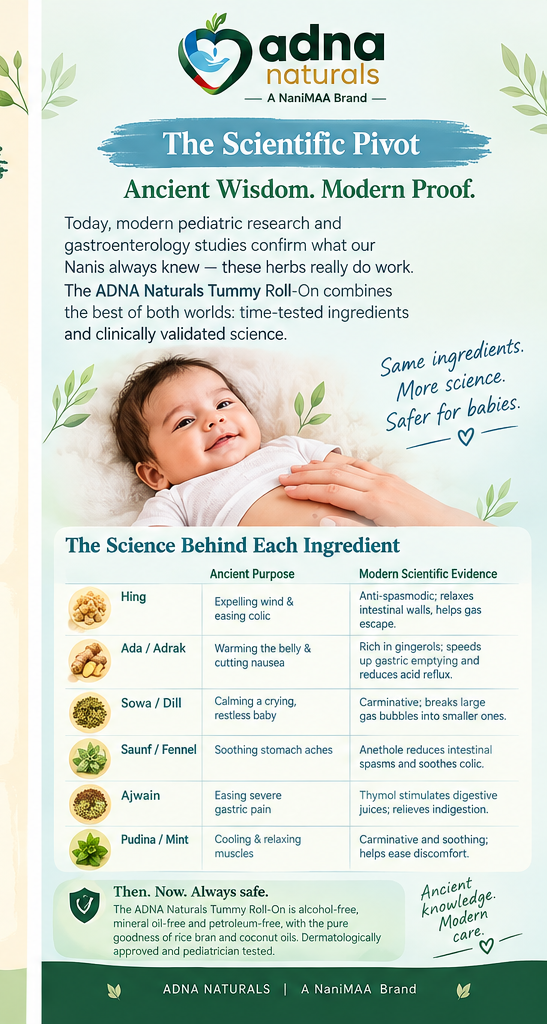
What Research and Traditional Knowledge Tell Us About These Ingredients
Hing (Asafoetida)
Traditionally associated with digestive comfort and relief from gas-related discomfort.
Adrak (Ginger)
Traditionally used for digestive comfort and nausea; ginger's naturally occurring compounds have been extensively studied.
Sowa (Dill)
Traditionally used as a digestive herb and for its aromatic, carminative qualities.
Saunf (Fennel)
One of the better-studied herbs in this group in relation to infantile colic. Clinical research has reported promising results for certain fennel preparations, although evidence remains limited.
Ajwain
A familiar Indian digestive herb traditionally used for gas and digestive discomfort.
Pudina (Mint)
Traditionally valued for its cooling and digestive properties; some mint preparations have also been investigated for gastrointestinal discomfort.

From the Kitchen Dabba to a Modern Roll-On
This is where ADNA Naturals brings the philosophy into the modern nursery.
Instead of asking today's parent to prepare a traditional household remedy from scratch, the ADNA Naturals Tummy Roll-On brings a carefully formulated blend of traditional ingredients into a convenient roll-on format.
The formulation includes:
Hing • Sowa • Saunf • Adrak • Pudina • Ajwain
along with its base ingredients.
According to the product label, the formulation is alcohol-free, mineral-oil-free and petroleum-free. The product is also labelled as clinically tested, pediatrician tested and dermatologically approved.
The result is a convenient way to incorporate traditional-inspired tummy care into a modern baby-care routine.
Another Quick Question to Consider
When your little one is uncomfortable, would you rather search through the kitchen cupboard for ingredients and prepare a traditional remedy yourself — or have a convenient roll-on designed specifically for easy application?
That is the difference between remembering Nani Maa's wisdom and adapting it for today's parents.
The Modern Convergence: ADNA Naturals Tummy Roll-On
At ADNA Naturals, we believe traditional wisdom doesn't have to disappear just because modern parenting has changed.
It can evolve.
The ADNA Naturals Tummy Roll-On is inspired by the familiar ingredients and tummy-care traditions passed down through generations, while offering parents a convenient, ready-to-use format.
Generational wisdom. Thoughtful formulation. Modern convenience.
Because sometimes, the best way to honour Nani Maa isn't to copy her recipe exactly.
It's to understand the wisdom behind it — and thoughtfully bring it into today's world.


Comments